Bottle feeding, step by step
Feeding is the heart of newborn care. Done well, it's calm and quick. Done in a rush, it can cause aspiration — milk in the lungs. Take your time and follow these steps.
How to mix the formula
- Follow the ratio on your KMR tin exactly — usually 1 part powder to 2 parts warm water.
- Use freshly boiled water, cooled to body temperature (~100°F / 38°C). Test on your wrist — it should feel warm, not hot.
- Mix in a clean jar and shake well, or whisk to remove clumps. Let foam settle.
- Make only what you'll use within 24 hours and store in the fridge. Warm each feed in a cup of hot water — never the microwave (hot spots burn).
- Discard any formula left in the bottle after a feed. Wash bottles and nipples in hot soapy water and air-dry.
The right position
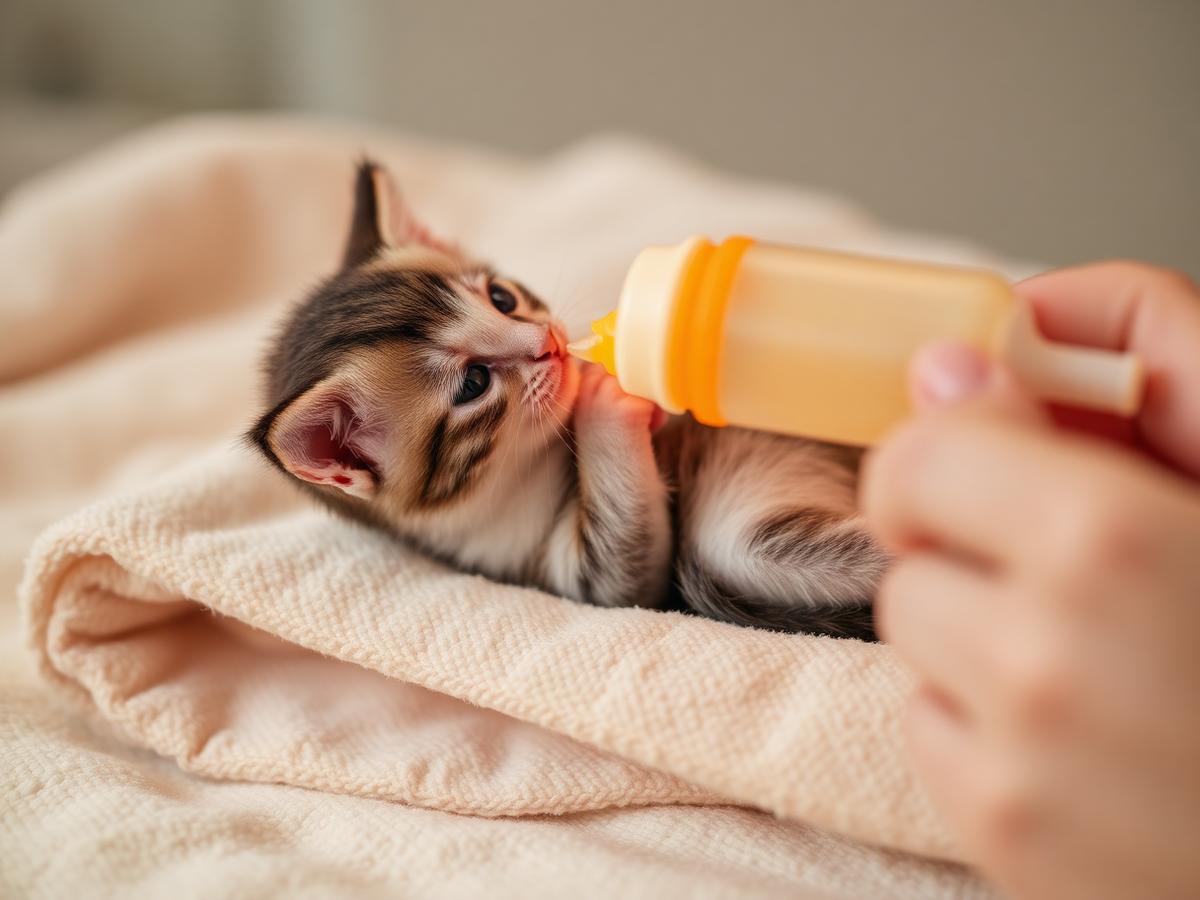
Always feed a kitten belly-down, with all four paws on a soft towel — exactly the position they'd nurse in from mom. Never feed a kitten on its back like a human baby — milk can enter the lungs and cause fatal aspiration pneumonia.
- Tilt the bottle so the nipple stays full of milk (no air bubbles).
- Let the kitten latch and suckle at its own pace. Do not squeeze the bottle.
- If milk bubbles from the nose, stop immediately, hold the kitten upright, gently wipe, and let them rest.
- Burp them after by holding upright against your shoulder and patting the back lightly.
How much and how often
| Age | How often | Per feed | Notes |
|---|---|---|---|
| 0–1 week | every 2 hours | 2–6 ml | Yes, including overnight. |
| 1–2 weeks | every 2–3 hours | 6–10 ml | One overnight feed is usually enough. |
| 2–3 weeks | every 3–4 hours | 10–14 ml | May start to drop the night feed. |
| 3–4 weeks | every 4–5 hours | 14–18 ml | Begin introducing gruel. |
| 4–5 weeks | 4 times a day + gruel | as much as taken | Weaning begins. |
| 5–8 weeks | Gruel becomes wet food | free-fed wet food | Bottle phased out. |
A good rule of thumb: kittens drink about 8 ml of formula per 100 g of body weight per day, divided across feeds.
If they won't latch
- Check the nipple hole. Hold the bottle upside down: one drop every second or two is right. No drips means the hole is too small (carefully enlarge with a hot needle). A stream is too fast.
- Try a Miracle Nipple — many kittens latch better on it.
- Make sure the kitten is warm. Cold kittens cannot nurse or digest. Warm them slowly first, against your skin, before trying again.
- If they still refuse for more than 4–6 hours, contact a vet. Syringe feeding (one drop at a time, slowly) may be needed.
Weaning (around 4 weeks)
Mix KMR with a little warm water and a spoonful of high-quality kitten wet food into a soupy gruel. Offer it on a flat plate. Most kittens walk in it before they eat it — that's normal. Over 2–3 weeks, gradually reduce the formula and increase the wet food until they're eating plain wet kitten food at 6–8 weeks.
Always have a shallow bowl of fresh water available once they're eating solids.
Aspiration is the #1 risk
If milk bubbles from the nose or you hear a wet cough, stop feeding, hold the kitten upright, and call a vet. Aspiration pneumonia can develop within hours.